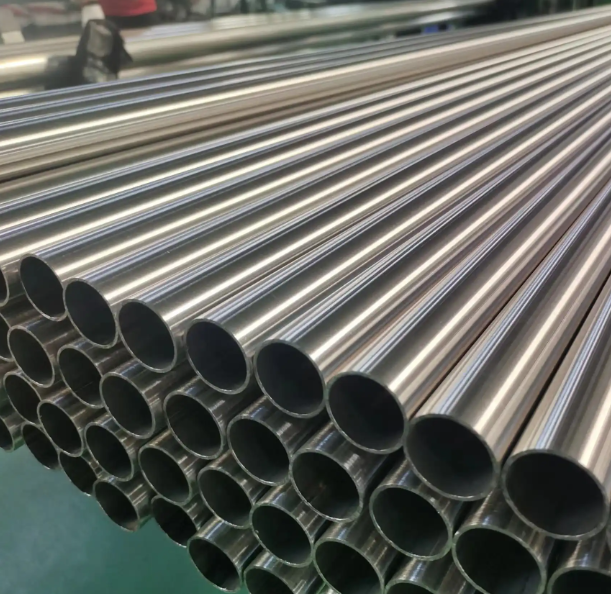
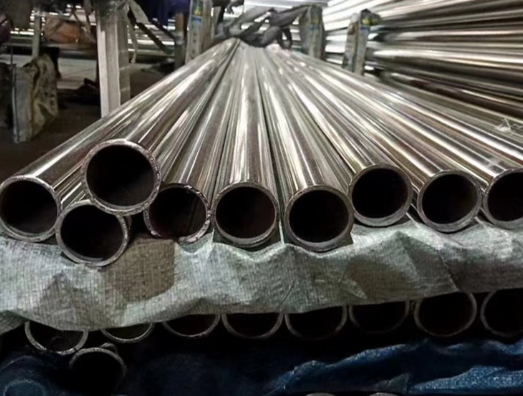
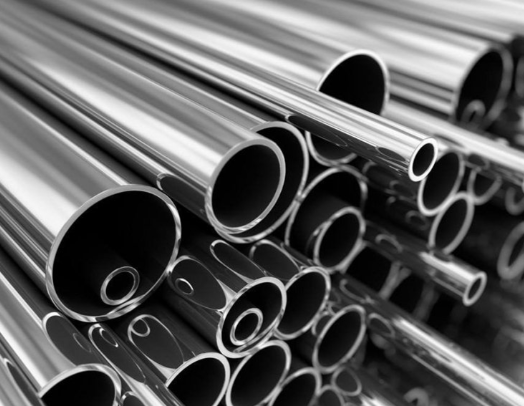
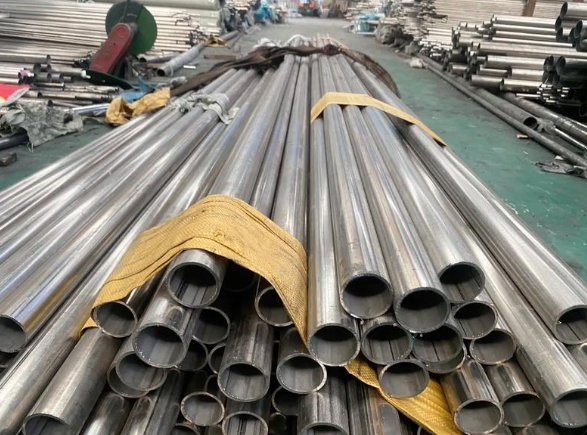
201 Stainless Steel Pipe
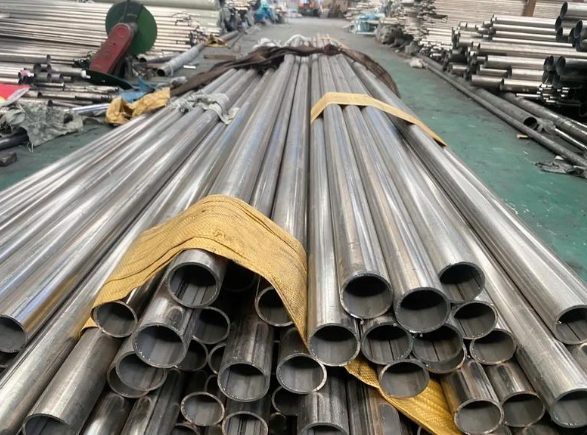
The 201 Stainless Steel Pipe is a cost-effective, chromium-manganese-nickel (Cr-Mn-Ni) austenitic stainless steel. Often referred to as a "lean nickel" alloy, it was originally developed as a substitution for the more expensive 300-series stainless steels (like 304) in applications where cost reduction is a priority. While it shares a similar appearance and austenitic structure with 304, the 201 grade utilizes manganese and nitrogen to stabilize the austenite phase instead of nickel, making it a popular choice in price-sensitive markets, particularly for structural and decorative purposes.
Material Properties & Chemical Composition
The defining characteristic of 201 stainless steel lies in its balanced chemistry. It contains approximately 16-18% Chromium, which provides the passive layer for corrosion resistance, and 3.5-5.5% Nickel. Crucially, it incorporates a higher percentage of Manganese (5.5-7.5%) and Nitrogen (up to 0.25%) to compensate for the reduced nickel content. This Mn-N substitution allows the steel to remain fully austenitic at room temperature. However, this chemical shift results in a material that is generally harder and stronger than 304 but possesses lower ductility and inferior corrosion resistance, particularly against pitting and crevice corrosion in chloride-rich environments.
Manufacturing Process
The production of 201 stainless steel pipes follows standard industry practices for austenitic stainless steels:
Seamless Route: A solid 201 stainless steel billet is heated and pierced to create a hollow shell. This shell is then rolled and stretched over a mandrel to achieve precise outer diameters and wall thicknesses. This method ensures a uniform structure without any weld seam.
Welded Route: A continuous strip of 201 stainless steel coil is formed into a tubular shape. The longitudinal seam is then welded, typically using High-Frequency Induction (HFI) or Tungsten Inert Gas (TIG) welding. Post-weld annealing is often performed to relieve stresses and restore corrosion resistance in the heat-affected zone.
Both methods conclude with solution annealing (heating to ~1050°C and rapid quenching) and pickling to remove scale and maximize surface passivation.
Key Features & Advantages
Economic Advantage: The primary selling point; significantly lower raw material cost compared to 304 due to the reduced nickel content.
Good Formability: Offers sufficient ductility for most standard fabrication processes like bending and rolling, though less so than 304.
High Strength: Generally exhibits higher yield strength and hardness than 304 stainless steel, providing robust mechanical performance.
Similar Appearance: Possesses the same bright, silvery finish as 304, making it visually interchangeable for decorative applications.
Weldability: Can be welded using conventional techniques, although filler metals should be carefully selected to match the chemistry.
Common Standards & Specifications
201 stainless steel pipes are manufactured according to various regional and international standards:
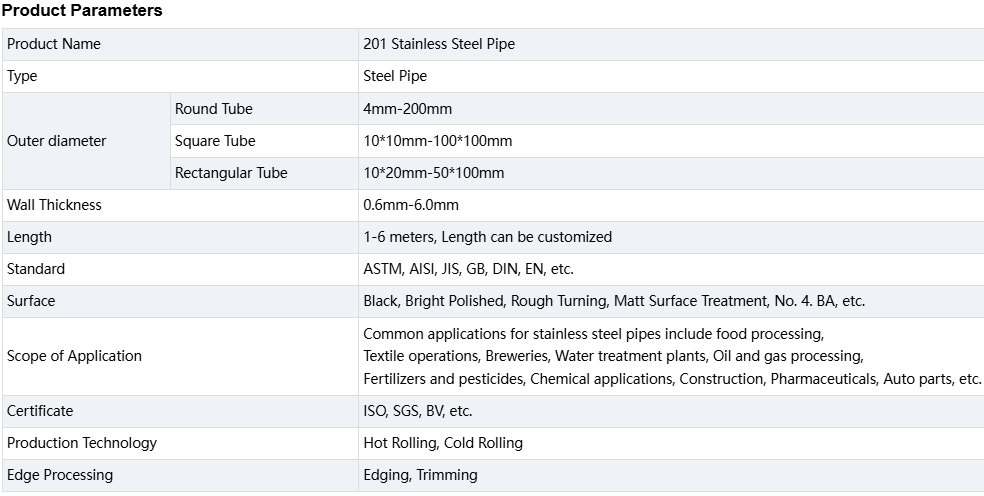
ASTM A312: Standard Specification for Seamless, Welded, and Heavily Cold Worked Austenitic Stainless Steel Pipes.
ASTM A554: Standard Specification for Welded Stainless Steel Mechanical Tubing (specifically for ornamental and structural tubing).
EN 1.4372: European standard designation (X6CrMnNiN17-7-5).
UNS S20100: Unified Numbering System designation.
Primary Applications
Due to its balance of cost and performance, 201 stainless steel pipe is widely used in:
Architectural & Decorative: Handrails, balustrades, building facades, and storefronts where aesthetic appeal is important but exposure to harsh elements is limited.
Automotive Trim: Interior and exterior decorative trim components.
Household Appliances: Structural frames and tubing for refrigerators, washing machines, and air conditioners.
General Fabrication: Furniture, display racks, and kitchen equipment where high corrosion resistance is not the primary requirement.
Transportation: Bus and truck bodies, and structural components in dry environments.
201 vs. 304: A Critical Distinction
Feature | 201 Stainless Steel | 304 Stainless Steel |
|---|---|---|
Key Alloying Element | Manganese & Nitrogen (Lean Nickel) | Nickel |
Corrosion Resistance | Good in mild, dry environments; Poor in chlorides | Excellent in a wide range of environments |
Cost | Lower | Higher |
Ductility / Formability | Moderate | Excellent |
Magnetic Response | May become slightly magnetic after cold work | Essentially non-magnetic |
Conclusion
The 201 Stainless Steel Pipe serves as an excellent budget-conscious alternative to 304 stainless steel for applications where exposure to corrosive agents is minimal and mechanical strength is sufficient. Its widespread adoption in architectural, decorative, and appliance manufacturing demonstrates its value as a practical engineering material, provided its limitations regarding corrosion resistance are properly understood and accounted for.
Previous:305 Stainless Steel Pipe
Next:309/309S Stainless Steel Pipe
