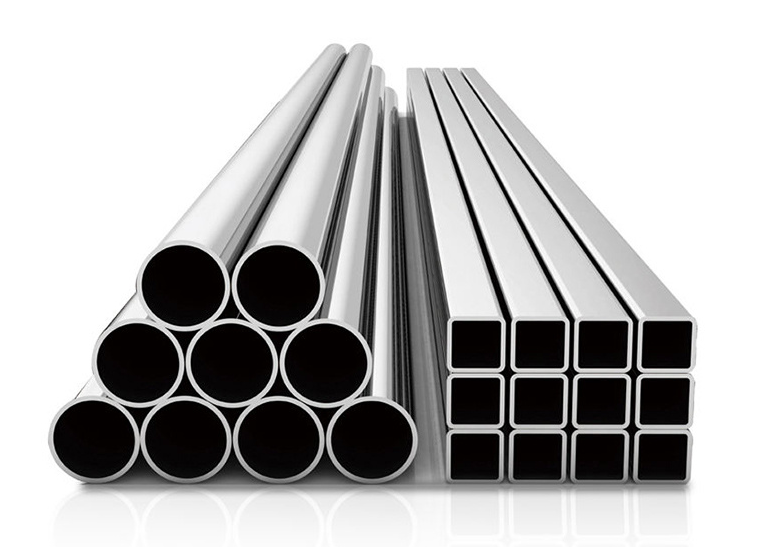
309/309S Stainless Steel Pipe
The 309 and 309S Stainless Steel Pipes are high-chromium, high-nickel austenitic alloys engineered for extreme high-temperature service. As a member of the 300-series family, these pipes are specifically designed to withstand oxidation, sulfidation, and creep at elevated temperatures where standard 304 or 316 stainless steels would fail. The "S" suffix in 309S denotes a low carbon content (max 0.08%), which is critical for preventing carbide precipitation and subsequent intergranular corrosion during welding, making it the preferred choice for welded assemblies operating at high temperatures.
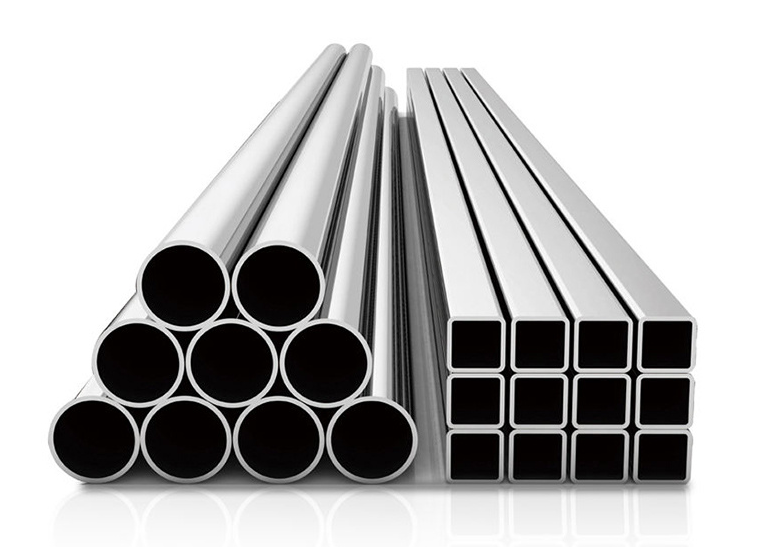
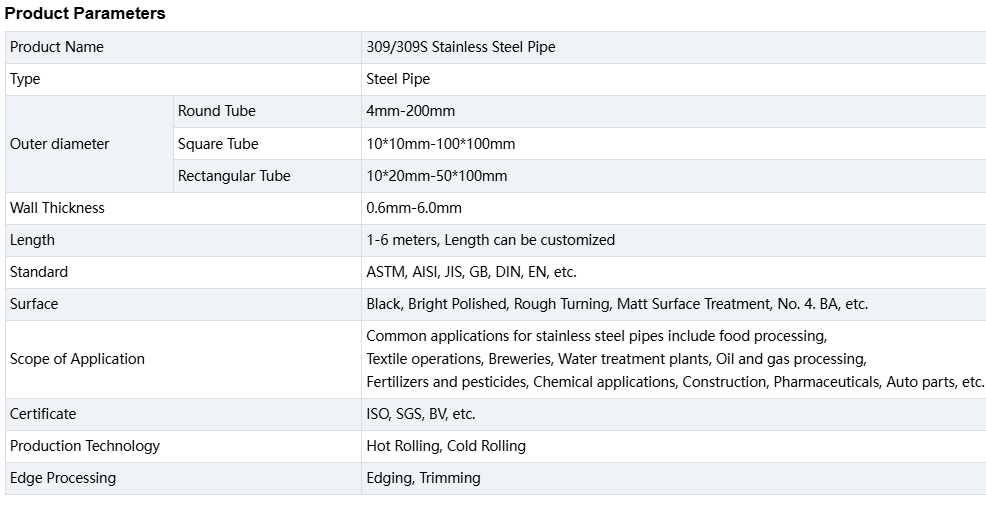
Material Properties & Chemical Composition
The superior high-temperature performance of 309/309S is derived from its robust chemical composition. Both grades contain approximately 23% Chromium and 13% Nickel. This high chromium content forms a dense, adherent oxide scale that protects the underlying metal from scaling and oxidation up to 1040°C (1900°F). The substantial nickel content stabilizes the austenitic structure, ensuring excellent toughness and ductility even at cryogenic temperatures, while also enhancing resistance to sulfur attack. The key distinction between 309 and 309S is the carbon control: 309S has a maximum carbon content of 0.08%, compared to 0.20% for 309, making 309S vastly superior in terms of weldability and post-weld performance.
Manufacturing Process
Given their demanding application in high-temperature environments, the manufacturing of 309/309S pipes emphasizes structural integrity and cleanliness:
Seamless Production: A solid billet of 309/309S is heated and pierced to form a hollow shell. It is then hot-worked and cold-drawn to achieve precise dimensional tolerances and a uniform grain structure throughout the pipe wall.
Welded Production: A flat strip is formed into a tube and longitudinally welded. Due to the high alloy content, welding often requires specialized filler materials (such as 309L or 310) and careful heat input control. The low-carbon 309S grade is almost always specified for welded fabrications to avoid sensitization.
Post-fabrication, the pipes undergo solution annealing and rapid quenching to dissolve carbides and restore the full corrosion resistance of the matrix.
Key Features & Advantages
Superior Oxidation Resistance: The high chromium content provides exceptional resistance to scaling and oxidation in air at temperatures exceeding 980°C (1800°F).
Excellent Creep Resistance: Retains its mechanical strength and dimensional stability under prolonged stress at high temperatures, which is crucial for furnace and kiln components.
Enhanced Sulfur Resistance: Superior performance compared to 304/316 in environments containing sulfur compounds, such as those found in certain petrochemical processes.
Improved Weldability (309S): The low carbon content of 309S virtually eliminates the risk of intergranular corrosion in the heat-affected zone, allowing for fabrication without post-weld heat treatment.
Dual-Purpose Utility: While optimized for high temperatures, these alloys also perform well in moderately corrosive aqueous environments.
Common Standards & Specifications
These alloys are manufactured to stringent standards for high-performance applications:
ASTM A312: Standard Specification for Seamless, Welded, and Heavily Cold Worked Austenitic Stainless Steel Pipes.
ASTM A213 / A249: Standards for seamless and welded boiler, superheater, and heat-exchanger tubes.
UNS Designations: S30900 (309) and S30908 (309S).
EN Standard: 1.4828 (X15CrNiSi20-12) for the European equivalent.
Primary Applications
The unique properties of 309/309S pipes make them indispensable for high-temperature industrial processes:
Industrial Furnaces & Kilns: Radiant tubes, muffles, retorts, and thermocouple sheaths.
Petrochemical & Refinery Equipment: Catalyst regeneration units, ethylene cracking tubes, and high-temperature heat exchangers.
Boiler and Power Generation: Superheater and reheater tubing in utility and industrial boilers.
Welding Consumables: Often used as filler metal for joining dissimilar stainless steels or carbon steels to stainless steels (e.g., joining 304 to carbon steel).
Automotive Exhaust Systems: Heavy-duty exhaust manifolds and catalytic converter casings in diesel engines.
Previous:201 Stainless Steel Pipe
Next:303 Stainless Steel Pipe
